The suicide question

Suicide. Just typing the word sends chills up my spine.  On a few occasions, I have ministered to families who had a family member take their own life and I have seen up close the enormous pain and despair that comes.  A couple of weeks ago, the son of well known pastor Rick Warren took his own life. Today the community where I serve has once again been touched by a suicide. My heart has been heavy all day for this family.  It is at times like this when pastors get what I call “the suicide question.”  Most often, it comes in this way: “Can a person who has committed suicide go to Heaven?”  I really don’t know where it originated, but many Christians tell me they “have always heard” that a person who commits suicide cannot go to Heaven, no matter their spiritual commitment beforehand. It’s an issue that many Christians struggle with, and I decided to address it in the blog today.

I believe that the central issue in discussing this question is the Biblical teaching regarding justification – that is how lost sinners are forgiven of their sin and made right with God. The Bible clearly teaches that sinners are made right with God by grace through faith in Jesus Christ…

for all have sinned and fall short of the glory of God, being justified freely by His grace through the redemption that is in Christ Jesus,” (Romans 3:23–24, NKJV)

Therefore, having been justified by faith, we have peace with God through our Lord Jesus Christ,” (Romans 5:1, NKJV)

For by grace you have been saved through faith, and that not of yourselves; it is the gift of God, not of works, lest anyone should boast.” (Ephesians 2:8–9, NKJV)

Without delving into a host of Biblical and theological issues, suffice it to say that the Bible teaches that we are justified (forgiven of our sin and made right with God) at the moment we repent of our sins and place our faith in Christ.  Justification is not a feeling, but it is rather a standing before God. It is our standing before God that is His work, not ours. Romans 8:33 reminds us that “it is God who justifies.” Furthermore, the Bible teaches that justification is a fixed, final, eternal standing before God.  In other words, we are not justified today and unjustified tomorrow depending on our feelings or behavior.  In fact, the Bible teaches that a person who is justified will absolutely and finally be glorified (made like God to live with Him forever)

And those He predestined, He also called; and those He called, He also justified; and those He justified, He also glorified.” (Romans 8:30, HCSB)

The verb tenses in Romans 8:33 are telling as well. Where I grew up, people would say, “It’s a done deal.”  That’s what Romans 8:33 says. Just as sure as God has justified a person, He has already glorified that person. They will be glorified for certain, and it is so certain that God’s Word speaks of it as if it has already happened.  Therefore a person who has given their life to Christ cannot be justified one day and then do something to lose their justification the next. The Bible teaches that a person cannot do anything to deserve or earn their salvation. That only comes by grace through faith in Jesus Christ.  Therefore, since a person did nothing to earn or deserve their salvation, but received their justification as a free gift (Romans 6:23) then a person’s salvation is eternal and irrevocable (eternal security, “once saved always saved”). If we did nothing to earn or deserve our salvation, then we we can do nothing to lose our salvation.

What does all of this have to do with the suicide question?   I believe that once a person has sincerely trusted Christ alone for their salvation, then nothing they do can change that relationship. It’s like my own two sons. They might sin terribly and break my heart, but they will always be my sons.  Nothing they could ever do would stop them from being my sons. Why?  Because they are my sons and that is the nature of the relationship.  So it is with children of God.  Nothing a child of God can do will sever the relationship – even something as horrific as suicide.

That being said, please allow me to conclude with several important truths to help put all of this into some perspective…

1)  Suicide is NEVER a legitimate option for a believer.

The Christian worldview upholds the sanctity of all human life from conception to natural death – including our own life.  While I do not believe that suicide is the “unpardonable sin” it is, nevertheless, a grievous sin.  It is a sin against God, ourselves, our family, and everyone who knows us.  While I do believe that it is possible for a true believer to reach a depth of pain and despair that is so great they take their own life, it is never right to do so.

2)  Suicide doesn’t end the pain; it just shifts the pain to others.

The guilt felt by the family left behind is often unbearable.  While the person who commits suicide often does it to relieve their own pain, it is the beginning of years, decades, and generations of pain for those who are left.

3)  There is nothing you can say.  Just be there to cry and pray with them.

When I first started out in ministry, I used to think that I had to say something profound that would relieve a family’s hurt. Then I realized the most important thing I could do was be there. No words can ease the pain for the family that is touched by a suicide, but your presence and prayers can help greatly.

Suicide is a complex issue that has no easy answers. It is my prayer that this post will help believers begin to think clearly about it and bring comfort to those who are struggling. The applications of the Bible truths we discussed apply to far more than just instances of suicide. Thanks for reading.

Run to God

Where do you go when you are troubled?  All of us turn somewhere when we are feeling overwhelmed, run down, confused, hurting, or otherwise fed up with life. Some of us turn to food, immersing ourselves in a favorite TV show, a favorite hobby,  or a host of other things.  Some run to alcohol, pornography, sex, or other destructive behaviors. Others might seek out the company of a particular friend or go to a particular place.  All of us go somewhere when we are troubled. Where do you go?

The Word of God tells us where we are to go when we are troubled…

God is our refuge and strength, A very present help in trouble.” (Psalm 46:1, NKJV)

God is our refuge and strength, but we have to chose to allow Him to be that for us. We have to run to Him when we are troubled. The truth is that everything in us will pull against that – our emotions, thoughts, etc.  Our sinful flesh wants us to turn anywhere other than the One who can truly help and satisfy. This fact is why we must fight through our feelings and run to God our refuge even when in ourselves we desperately want to run somewhere else.  The truth is that if we are not running to God, then we are running away from Him.  Run to God when you are troubled because He alone gives peace…

Therefore we will not fear, Even though the earth be removed, And though the mountains be carried into the midst of the sea;” (Psalm 46:2, NKJV)

Believing God to the very end

The Old Testament life of Joseph is a favorite character study for many Christians. Recently, I preached a series of messages on the life of Joseph at our church, and I found that one less well known moment in Joseph’s life was a great blessing to me.  If you haven’t in a while, take a few minutes and read the life of Joseph as recorded in Genesis 37-50.  It will bless you.

Joseph is a great example of perseverance and overcoming terrible hurts, as well as a great example of leadership and hard work.  Joseph grew up in a dysfunctional family where his father favored him above his eleven brothers. This fact created resentment to the point where his brothers threw him in a pit and plotted to kill him.  Slightly cooler heads prevailed and his brothers decided to sell him into slavery in Egypt and tell their father that Joseph was dead. The Bible says that the Lord was with Joseph in Egypt and he eventually gets a good position working for Potipher, an Egyptian official.  However, then he is falsely accused of a crime and is forgotten about in years of imprisonment.  Miraculously, the Lord works in Joseph’s life and he eventually is released from prison and winds up running the entire country of Egypt to prepare for seven years of terrible famine. The Lord actually used Joseph to save the lives of millions of people! Finally, he is reunited with his brothers and forgives them even though he is in a position to exact revenge.  It’s a truly amazing life story!

However, it is also interesting to make note that Joseph is mentioned in the “Faith Chapter” better known as Hebrews 11.  Some preachers call this “Faith’s Hall of Fame”  because Hebrews 11 recognizes many well known (and some less well known) Old Testament believers and commends them for what they did for the Lord through faith in Him.  It’s an inspiring chapter to say the least.  Not surprisingly, Joseph is mentioned in Hebrews 11 and commended as a man who lived by faith in the Lord. It is not surprising that Joseph is mentioned in Hebrews 11, but it is surprising to read what he is commended for…

By faith Joseph, when he was dying, made mention of the exodus of the sons of Israel, and gave orders concerning his bones.” (Hebrews 11:22, NASB95)

This is a reference to Genesis 50:22-26 where Joseph’s dying wish is that his bones be taken to the promised land and buried there. You see, Joseph’s great grandfather was Abraham, to whom the Lord had promised the land around 200 years before (Genesis 12:1-3, 15:1-7). At the time of Joseph’s death, none of these promises had been fulfilled and Joseph and his descendants all lived in Egypt, not the promised land. Yet, Joseph believed the promise of God that one day God would keep his word and bring them to possession of the promised land. As a result, Joseph basically said, “I don’t want to be buried here among unbelievers. I want to be finally buried in the promised land because one day God is going to bring us there!”

Think about all of the great things that Joseph did through his faith in the Lord. Think of all of the great things the Lord could have inspired the writer of Hebrews (whomever that may be!) to commend in Joseph’s life. Yet, the Holy Spirit chose to commend Joseph for believing God to the very end of his life by giving instructions concerning his bones. Joseph died believing the promises of God, and that is what the Lord commended him for. By the way, if you study the Old Testament, you will find that it was another 400 years before Joseph’s bones were actually buried in the promised land, but they got there!

May each of us be like Joseph and believe the promises of God to the very last breath we take on this earth!  Don’t let circumstances and the way things look right now discourage you. On the day Joseph died, nothing around him looked like God was keeping his promises, yet he died believing God – the One who cannot lie and cannot fail!   Let’s each one determine to believe God until our dying breath.

Praying for revival

“Restore us, O God of our salvation, And cause Your anger toward us to cease. Will You be angry with us forever? Will You prolong Your anger to all generations? Will You not revive us again, That Your people may rejoice in You?” (Psalm 85:4–6, NKJV)

Many Bible scholars believe that Psalm 85 was written after the people of God had returned from exile in Babylon. They were back home in their land, but things were but a shell of what they had been before the Babylonian captivity. This is a great Bible prayer for revival among the people of God. While many readers of this blog will be familiar with old fashioned “revival meetings” where evangelists preach and call on people to be saved, I think it is important to point out that revival is first and foremost for the church. The people of God need to get back to a white hot devotion to their Lord and let His power work mightily among them.  Certainly, during every revival in history, many lost people have come to faith, but revival begins among the people of God.

I cannot stress enough how much we need a great revival today in America. In recent months, I have been burdened to pray for revival more than ever before in my life and ministry.  As I look around at our country, I am personally convinced that America is headed for one of two outcomes: revival or ruin.  I truly believe that the only thing that can save our country is a mighty movement of God – a revival.

This week, I had the privilege of attending a conference where Dr. Ted Rendall spoke. It was a great delight and blessing to hear and get to know this choice servant of Christ. He has served as a missionary, senior pastor of a large church, and president of a Bible Institute. He has preached all over the world and served in full time ministry in England, Canada, and the United States. He is also one of the foremost experts in the world on revival and spiritual awakening. During a break, I had a conversation with Dr. Rendall and asked him about revival in America.

“Dr. Rendall,” I asked, “From all that you know about revivals and spiritual awakening, is there hope for revival to come to America?”  Without even a pause, Dr. Rendall quickly said, “Of course, there is great hope for revival in America!”  I followed up with the logical question, “Why?”  His answer encouraged me. “Remember that as bad as things are in America, there are thousands upon thousands of preachers preaching the gospel and the Word of God, ” Dr. Rendall replied, “Think about how many Christians in America are praying for revival. As long as those things are true, there is hope for God to send revival.”

Then, Dr. Rendall looked me in the eye and offered a challenge. “The church has to get burdened and earnestly pray for revival,” he said.  A few moments later the conference resumed and our conversation ended.  However, it has echoed in my mind ever since. Count me encouraged by the hope this man of God has for revival. Count me convicted by his challenge to have a greater burden for revival.  Will you be counted too?

How beautiful is the body of Christ!

Recently, I had the privilege of attending a conference with pastors from a variety of backgrounds. As we sang the universal hymn, Amazing Grace, I was touched as I looked around the room. There were men of all ages in the room, but the most striking detail was the ethnic and national diversity in the room.  I was singing Amazing Grace with pastors from all over the United States, as well as South Africa, West Africa, Nigeria, Mozambique, Philippines, Singapore, and a seminary president from India.  All of this diversity in a room with no more than fifty people.

As we sang together, I couldn’t help but think of Ephesians 2:14-15 that speaks of how the work of Christ has torn down the walls between people and created one new people in Christ Jesus.  This roomful of men from the far corners of the world who had never met immediately came together around the amazing grace of God. THAT is what we all have in common. We prayed together, studied together, and ate together. The love of Christ was evident throughout.  Encouragement was everywhere!  All of us were reminded in a tangible way that our great God is at work all over the world.

The body of Christ is a beautiful thing.

Part of my heart will always be at Pisgah

On Wednesday, I had the privilege of preaching the funeral service for Florene Wheeler, a faithful prayer warrior and friend who passed away at the age of 97. It was a very sad occasion, but it was also a joy to spend the day with people I love deeply. You see, Florene was a near lifetime member of Pisgah Baptist Church in Pisgah, Alabama.  In February, 1994 Becky and I moved to Pisgah as 23 year old newlyweds, and I began serving as the pastor of Pisgah Baptist Church.

Pisgah_Baptist_Outside

I have often said that I do not know much now, but I did not know anything then!  Becky and I moved into the pastorium just behind the church building here and began our life and ministry together. In the afternoons we would take walks around this beautiful community, and very often would come home to a sack of fresh garden vegetables on our front porch. Pisgah High School is only two blocks away and we spent many evenings at various Eagle sporting events. I can remember Vacation Bible School with kids running all over the church grounds.  I remember Andrea Wheeler, the first person who was saved and baptized under my ministry as a pastor.

Sanctuary

This is the pulpit from which I preached my first sermon as a pastor and many sermons thereafter. However, it is the people who were in those pews that I treasure most. Whenever I look at this picture, I can see friends for life in those pews. I see Derrick & Florene Wheeler, Ollie & Betty Turner, Delton & Jean Traylor, “Coach” & Elizabeth Cooley, Jerry & Carolyn Jeffrey, Bill & June Corbin, Jack & Jewel Brewster, and a host of others.  I can see the “Wheeler girls” up on that stage singing. I can see people being saved and baptized in that very room.

The precious people at Pisgah Baptist Church loved me and were patient with me. They loved the Word of God and came hungry for it every service. They didn’t just see themselves as my ministry, but rather they saw me as their ministry.  They urged me to stay in seminary classes and even helped to pay for my ministry training knowing that I likely would not stay there very many years. They prayed for me. On a handful of occasions, they cried with me. They loved my wife, and let her settle into the role of a pastor’s wife with no pressure to do everything in the church.  I absolutely could not have asked for a better first church to pastor.

On Wednesday as I drove up to Pisgah, all of these memories came flooding back. As a walked into the building, it was like home as always. After a few hours of countless tears, hugs, and a funeral, I pulled out of the parking lot to head back to Huntsville. With tears streaming down my cheeks, I thanked the Lord for this precious church and all that it has meant to me. Everything I do for the Lord today is very much because of their influence in my life.  They have truly meant more to me than I could ever mean to them. This is why, no matter where I go or what I do for the Lord the rest of my life, part of my heart will always be at Pisgah.

Easter Sunday and every Sunday

1 Corinthians 15 is one of the most famous chapters in the Bible. It is commonly referred to as the “Resurrection Chapter” not because it tells the story of Jesus’ resurrection but because it speaks of the necessity of it and how it applies to our lives today. As we approach Easter Sunday, I encourage all of my readers to take some time and read through this great chapter.  I intend to do so with my own family during our family devotional times.  Let’s look at some key points of this chapter…

“Now if Christ is preached, that He has been raised from the dead, how do some among you say that there is no resurrection of the dead? But if there is no resurrection of the dead, not even Christ has been raised; and if Christ has not been raised, then our preaching is vain, your faith also is vain. Moreover we are even found to be false witnesses of God, because we testified against God that He raised Christ, whom He did not raise, if in fact the dead are not raised. For if the dead are not raised, not even Christ has been raised; and if Christ has not been raised, your faith is worthless; you are still in your sins. Then those also who have fallen asleep in Christ have perished. If we have hoped in Christ in this life only, we are of all men most to be pitied.” (1 Corinthians 15:12–19, NASB95)

Here we see the absolute necessity of the resurrection to our faith. If He is not victorious then there is no victory for us. However, Christ has risen from the dead, so there is victory for us.  In fact, Paul goes on to explain that Christ’s resurrection restores spiritual life to sinful humanity who had lost their spiritual life through Adam’s fall in the garden of Eden…

“But now Christ has been raised from the dead, the first fruits of those who are asleep. For since by a man came death, by a man also came the resurrection of the dead. For as in Adam all die, so also in Christ all will be made alive.” (1 Corinthians 15:20–22, NASB95)

Because Jesus is victorious over sin, death, and the grave we can have that same victory through faith in Him!  Furthermore, Paul explains that Christ’s resurrection ensures our resurrection – comparing Christ’s resurrection as the first one of many to come…

“But each in his own order: Christ the first fruits, after that those who are Christ’s at His coming, then comes the end, when He hands over the kingdom to the God and Father, when He has abolished all rule and all authority and power. For He must reign until He has put all His enemies under His feet. The last enemy that will be abolished is death. For He has put all things in subjection under His feet. But when He says, “All things are put in subjection,” it is evident that He is excepted who put all things in subjection to Him. When all things are subjected to Him, then the Son Himself also will be subjected to the One who subjected all things to Him, so that God may be all in all.” (1 Corinthians 15:23–28, NASB95)

I hope that’s enough to get your Bible study juices flowing and encourage you to dig into 1 Corinthians 15 this week as we count down to Easter Sunday – resurrection Sunday!  A couple of years ago, I had the opportunity to travel to Israel for the first time to visit the Biblical sites. Of course, one of the great highlights of any trip there is a visit to the Garden Tomb…

GardenTombexterior

We do not know for sure exactly where Jesus was buried.  The Garden Tomb is one of two locations that many Christians believe to be the place. The other is found just a short distance away in Jerusalem inside the Church of the Holy Sepulchre.  The Garden Tomb has a number of characteristics that coincide with what we know from the Bible, making it the location that is preferred by most evangelical scholars today, although we cannot be certain.

GardenTombinterior1

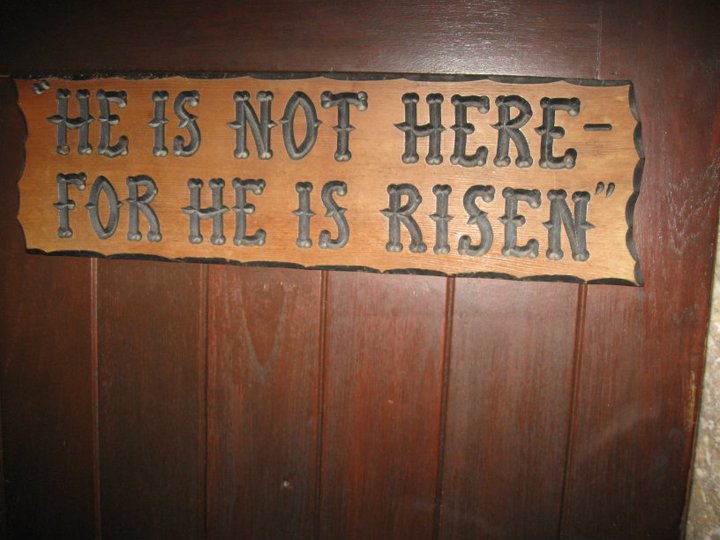
This is the burial chamber inside the Garden Tomb.  If Jesus was actually buried here, this is very likely the spot.  Take a moment and think about that. Every group that enters the Garden Tomb grows silent as this awesome thought sinks in. For me, it is a spiritually moving experience to be reminded in such a concrete way that I serve a risen Savior!  You see, the most important issue is not WHERE Jesus was buried, but rather THAT Jesus has risen!  Here is what you see above you as you exit the Garden Tomb…

GardenTombinterior2

Yes! That is what really matters! As the old hymn says, “I serve I risen Savior, He’s in the world today. I know that He is living whatever men may say…”  That is the message and the hope of Easter.  In fact, Easter Sunday is not the only Sunday that the Christian church celebrates the resurrection. Have you ever wondered why we worship on Sunday?  Because Jesus rose on Sunday.  The early Christians did not gather to worship on the Jewish Sabbath (Saturday) but gathered to worship on Sunday because that was the day their Savior rose.  So, every single time we gather for worship on Sunday, we are celebrating the resurrection of Christ.  Yes, Easter Sunday and every Sunday is resurrection Sunday!

I love the church, churches, and my church

Have you ever thought about the fact that Jesus only said that He was personally building one thing: the church?

““I also say to you that you are Peter, and upon this rock I will build My church; and the gates of Hades will not overpower it. “I will give you the keys of the kingdom of heaven; and whatever you bind on earth shall have been bound in heaven, and whatever you loose on earth shall have been loosed in heaven.” Then He warned the disciples that they should tell no one that He was the Christ.” (Matthew 16:18–20, NASB95)

Here Jesus speaks of the “universal” church, that is the ekklesia made up of all believers the world over who have ever lived, are living, and will ever live.  The Bible also speaks of what we call a “local” church, that is a gathering of Christians from a particular location.  For instance, many of Paul’s epistles begin with a reference to the saints in a particular city. That is they are addressed to particular churches.  Revelation 2-3 famously refer to the seven churches in Asia and there God speaks to specific local churches.  You really can’t separate those two ideas out.  I like to say that the local church is simply an expression of the universal church.

As Christians, we are to love BOTH the local church and the universal church. It’s easy to love the universal church. Just the thought of millions upon millions of fellow believers from almost all nations, races, and languages is an encouragement to us. There is nothing quite like traveling to another country and worshiping with other believers that you do not know and yet immediately sensing the Spirit of God in your midst.  While the church is struggling in North America right now, it is advancing strongly on every other continent. Jesus is truly building His church every single day. More people are coming to Christ the world over right now than at any time in world history. It just doesn’t appear that way if you are sitting in a church in America.  I love the universal church. It is a great encouragement to me.

This fact brings me to the local church. Probably, most readers of this blog are faithful members of a local church in the United States.  The local church is a little more difficult to love because we have seen it up close. We have seen churches grow, and we have seen churches implode. We have seen churches reach people and we have seen churches go for years without a single baptism. We have seen churches move ahead with great faith and unity, and we have seen way too many churches fall into severe conflict with collateral damage in the lives of countless people.  We have seen churches change and we have seen churches die. If we stop and think about it, we could all likely name a number of scandals involving a local church.  Depending on our particular experiences and perspective, the local church may or may not be a source of encouragement when you think about it.

Please let me share a word of exhortation here. I am one who has given my entire adult life to serving local churches – that’s over twenty years of full time ministry as a pastor. Certainly, I have seen the great, the good, the bad, and the downright ugly in the local church. I have seen the local church at its best and I have seen it at its worst, and I would absolutely do it all over again!  How do I say that?  Because I believe with all of my heart that the local church is the most important organization on the planet. Remember, the church is the only thing that Jesus said He is personally building. I want to invest my life in what is most important to Jesus!

The truth is that I love all Bible believing, gospel preaching, Jesus worshiping churches.  I have preached in churches of all sizes and in all types of  communities.  I love churches.  It fascinates me to see how God is working in each place. Certainly, I have seen many churches that could be more effective due to many factors, but I have yet to see a church that could not reach someone.  I have yet to see a church that did not have at least a handful of Godly, faithful people who longed for revival and to see their church reach others. I have yet to see a church that did not advance the kingdom and bring honor to Christ in some way.  I love churches.  Country churches, city churches, suburban churches, small churches, large churches, traditional churches, contemporary churches, you name them, I love them all.  Jesus is building His church, and that is evident through His work in local churches all over the world.

Now, let’s think for a moment about “my church” that is the church I presently serve, Whitesburg Baptist Church.  You know the church that you go to is like your family.  Deficiencies and shortcomings quickly come to mind!  Why is that?  Because we see the blemishes of those we are closest to.  All of us who attend church faithfully could list numerous ways that our church could be better.  It is at our home church that we see up close and personal that the church is people and therefore imperfect. Nevertheless, I love my church. There is far more right with Whitesburg than wrong with Whitesburg. Some of the finest Christians I have ever known are part of the Whitesburg family. Each year, hundreds of people give their life to Christ through my church’s influence. Some of the closest friends I have in this world are at Whitesburg.  The Bible is preached and Christ is exalted at Whitesburg. I love my church.

So there you have it. I love the church universal, the church local, and I love my church.  Jesus is at work building His church, and it is a great joy of my life to be a small part of what He is doing in the church. No matter what may be going on in your particular church, don’t give up. God is not out of business. Love the church, churches, and love your church!

Life verses #2 – Ephesians 4:32

“Be kind to one another, tender-hearted, forgiving each other, just as God in Christ also has forgiven you.” (Ephesians 4:32, NASB95)

Recently, I saw a “tweet” from a Christian leader who pointed out that we really don’t hold grudges, but rather grudges hold us. That is so very true. Bitterness and grudges have been around since the very beginning of time. Remember Cain and Abel?  However, from where I sit, it appears to me that anger and bitterness is running rampant in our culture in a way that I have never seen before. So many live in the bondage of unforgiveness. Unfortunately, a large percentage of Christian believers live in that bondage too.

Like many Christians, I sometimes struggle with forgiveness. It certainly doesn’t come naturally, does it?  However, forgiveness is not an option if we are to live faithfully for Christ. We cannot bear spiritual fruit and know the joy of the Lord if our hearts are filled with bitterness and anger. On the surface, this appears irreconcilable, doesn’t it?  On the one hand, forgiveness is absolutely necessary, but on the other hand forgiveness goes against everything that we naturally feel.  It is certainly no surprise that the overwhelming majority of people live their lives in the bondage of unforgiveness. It is what comes most naturally.

Ephesians 4:32 reminds us as Christians that forgiveness is a SUPERNATURAL part of our lives. Notice that we are not encouraged to forgive because we are so good and kind. The basis of our being able to forgive others is the powerful forgiveness of Christ that we have experienced for our own sin.  We can forgive because we have experienced such incredible forgiveness ourselves. Christ forgave us of our sins and we certainly do not deserve it. Therefore, because we have experienced love, grace, and forgiveness in our own lives, we can extend them to others who have hurt us.

Ephesians 4:32 is one of my life verses because each year I find myself coming back to it on multiple occasions. Life hurts. Family hurts sometimes. Ministry and church hurts sometimes.  I have learned to run back to this verse when I sense that I am struggling to forgive.  This serves two purposes. First, it reminds me that I can forgive and the ability to forgive is not based on my goodness, but on the goodness of Christ.  Finally, it also reminds me of the greatness of my salvation.  Christ has forgiven me of all of my sins; he came into this world to save sinners – of whom I am chief!  Once I am reminded of those two great truths, then I tend to be in a more ready mindset to forgive and move on.

Do you need to forgive someone today?  Make Ephesians 4:32 one of your life verses.